

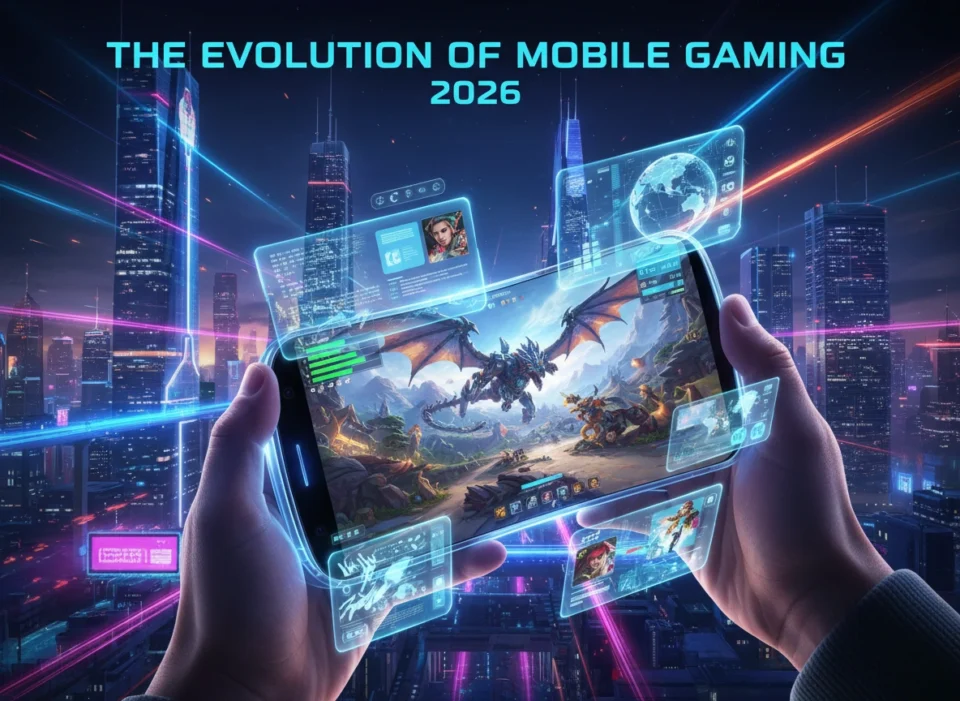
Mobile gaming has transformed from a simple pastime into a global entertainment powerhouse. By 2026, this evolution has reached a new peak, driven by technological leaps and changing player expectations. What was once defined by basic puzzle games on a morning commute is now a sophisticated ecosystem of high-fidelity, immersive, and competitive experiences. We will explore the key advancements that have redefined mobile gaming, from the widespread adoption of 5G and cloud services to the integration of artificial intelligence and augmented reality.
This article breaks down the major forces shaping the mobile gaming landscape in 2026. We will look at how faster networks are making console-quality gaming on the go a reality, how AI is creating more dynamic and personal experiences, and how mobile devices are becoming the new frontier for virtual and augmented worlds. Finally, we will examine the explosive growth of mobile eSports and what it means for the future of competitive gaming.
The 5G and Cloud Gaming Revolution
The promise of 5G has become a tangible reality, and its impact on mobile gaming cannot be overstated. This technology is the backbone of the most significant shift in how we access and play games: cloud gaming. In 2026, players are no longer limited by the processing power of their devices. Instead, they stream AAA, graphically intensive titles directly from powerful remote servers to their smartphones and tablets.
Unlocking Console-Quality Experiences
Cloud gaming services like Xbox Cloud Gaming, NVIDIA GeForce NOW, and others have matured significantly. Thanks to the ultra-low latency and massive bandwidth of 5G networks, the input lag that once plagued game streaming is now negligible for most players. This has effectively turned every high-end smartphone into a portable console. A player can start a game on their living room TV and seamlessly continue their session on their phone during a lunch break, with no loss of quality or progress.
This shift has also changed the economics of gaming. Instead of purchasing expensive dedicated hardware, many gamers opt for subscription-based cloud services. This model provides access to vast libraries of games for a monthly fee, lowering the barrier to entry for high-end gaming. Mobile device manufacturers are also responding, designing phones with features specifically for cloud gaming, such as high-refresh-rate OLED screens, integrated controller attachments, and advanced cooling systems to handle prolonged use.
The Impact on Game Development
Developers are no longer as constrained by the hardware limitations of the average smartphone. They can build games with the complexity, graphical fidelity, and scale previously reserved for PC and console platforms, confident that a large portion of their audience can stream it. This has led to a surge in cross-platform titles that offer an identical experience, whether played on a console or a mobile device. The line between a “mobile game” and a “console game” has become increasingly blurred.
The Rise of AR and VR in Mobile Gaming
Augmented Reality (AR) and Virtual Reality (VR) have moved from niche novelties to integral components of the mobile gaming experience. While full-scale VR remains predominantly a dedicated-headset affair, mobile-powered AR and lightweight VR viewers have found a solid footing, creating new and engaging forms of interactive entertainment.
Augmented Reality: Blending Worlds
AR gaming has evolved far beyond the simple “catch them all” mechanics that first brought it to mainstream attention. In 2026, mobile games use sophisticated environmental mapping and object recognition to create deeply interactive experiences. A player’s living room can become a fantasy dungeon, with monsters hiding behind real-world furniture. Board games come to life with animated pieces and dynamic effects visible through a phone’s camera.
Developers are using AR to create social, location-based games that encourage players to explore their cities and interact with one another. These games overlay digital content onto the real world, turning public parks into battlegrounds and historical landmarks into quest hubs. The technology has fostered a new sense of community and shared adventure, all powered by the device in everyone’s pocket.
Mobile VR: Accessible Immersion
While high-end VR requires powerful PCs, mobile VR has carved out a space focused on accessibility. Using lightweight, affordable headsets that pair with a smartphone, players can enjoy immersive experiences without a significant investment. These games often focus on puzzles, narrative-driven adventures, and social VR spaces. They serve as an excellent entry point into virtual reality, introducing millions to the potential of fully immersive digital worlds.
The Role of AI in Enhancing Gameplay
Artificial Intelligence is the unseen engine elevating mobile games from simple programs to dynamic, responsive worlds. In 2026, AI is used in everything from personalizing player experiences to creating more believable and challenging non-player characters (NPCs).
Procedural Content Generation (PCG)
Developers are heavily utilizing AI-driven Procedural Content Generation to create vast and endlessly replayable game worlds. Instead of manually designing every level, forest, or city, developers set rules and parameters, and an AI algorithm generates the content. This means that every player’s experience can be unique. It allows smaller studios to create games with a scope and scale that would have once required a massive team.
Adaptive AI and Personalized Experiences
Modern mobile games use AI to learn from a player’s behavior. The AI can dynamically adjust the difficulty, ensuring the game remains challenging but not frustrating. If a player is struggling with a particular section, the game might offer subtle hints or reduce the number of enemies. Conversely, for a skilled player, it can introduce more complex challenges.
This personalization extends to content as well. AI algorithms curate daily quests, recommend in-game items, and even generate narrative elements tailored to a player’s preferences and playstyle. This makes the gaming experience feel more personal and keeps players engaged for longer periods. NPCs are also more intelligent, exhibiting complex behaviors, remembering past interactions with the player, and reacting realistically to the changing game world.
The Growing Importance of Mobile eSports
Mobile eSports has shed its “little brother” status and now stands shoulder-to-shoulder with its PC and console counterparts. The accessibility of smartphones has created a massive global talent pool, and in 2026, mobile eSports tournaments command huge audiences, substantial prize pools, and dedicated professional leagues.
A Truly Global Stage
The barrier to entry for mobile eSports is significantly lower than for PC gaming. Nearly everyone has a capable device, which has democratized competitive gaming on a global scale. Players from regions without a strong PC gaming infrastructure are now competing and winning on the world stage. This has led to an incredibly diverse and vibrant competitive scene.
Games built specifically for mobile competition—featuring short match times, intuitive touch controls, and deep strategic elements—dominate the eSports charts. These titles attract millions of viewers on streaming platforms daily. Professional organizations now have dedicated mobile rosters, and players can earn a living through prize money, sponsorships, and streaming revenue, just like in traditional eSports.
The Future of Competitive Entertainment
The rise of mobile eSports has also attracted major brands and investors. Tournaments are held in large arenas, broadcast on major networks, and sponsored by global companies. The integration of 5G technology has also improved the integrity of mobile competitions, providing stable, low-latency connections essential for high-stakes play, even when competitors are in different locations.
Conclusion: A New Era for Gaming
The evolution of mobile gaming in 2026 is a story of convergence. Technologies like 5G, cloud computing, AI, and AR have broken down the barriers that once separated mobile gaming from traditional platforms. The device in your pocket is now a gateway to console-quality graphics, endlessly dynamic worlds, and global competitive arenas.
For players, this means more choice, higher quality, and more immersive experiences than ever before. For developers, it opens up a world of creative possibilities, free from many of the old hardware constraints. As technology continues to advance, the distinction between “mobile” and “mainstream” gaming will fade further, solidifying mobile’s position not just as a part of the gaming industry, but as its driving force.
Please visit this website for more info.
