
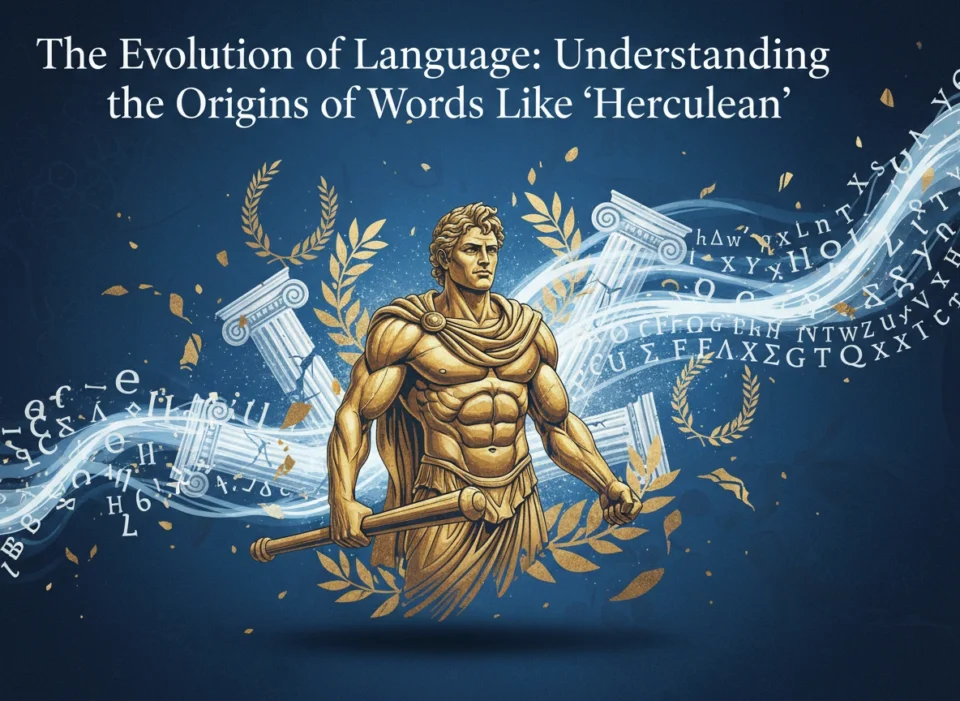
Language is not a static entity; it is a living, breathing organism that adapts, grows, and transforms alongside the civilizations that speak it. Every word we utter carries the weight of history, a hidden lineage of cultural shifts, conquests, and storytelling that stretches back thousands of years. While we often use words purely for their functional value, many terms in our modern lexicon serve as linguistic fossils—remnants of ancient myths and historical figures that have been repurposed for the digital age.
One of the most potent examples of this phenomenon is the word “Herculean.” When a project manager describes a looming deadline as a “Herculean task,” or a sports commentator refers to an athlete’s “Herculean effort,” they are unknowingly invoking the ghost of a Greek demigod. By examining the origins and evolution of this specific word, we can unlock a deeper understanding of how language evolves, how mythology permeates our daily speech, and how ancient stories continue to shape modern communication.
The Etymological Roots of ‘Herculean’
To understand the word, we must first understand the man—or rather, the myth. The term “Herculean” derives directly from Hercules, the Roman name for the Greek hero Heracles. Born of Zeus and the mortal woman Alcmene, Heracles was renowned for his extraordinary physical strength and his adventurous spirit.
The etymology traces back through Latin Herculeus (pertaining to Hercules) to the Greek Hērakleēs, which ironically means “Glory of Hera.” The name itself is a fascinating study in conflict, as Hera, the queen of the gods, was Heracles’ tormentor, not his patron.
The adjective “Herculean” entered the English language in the late 16th or early 17th century. Initially, it was used quite literally to describe something resembling Hercules in strength or size. If a man was exceptionally muscular, he was Herculean. However, the word’s meaning quickly expanded beyond physical attributes to encompass the nature of the tasks performed. This shift is directly tied to the central myth of the hero: the Twelve Labors of Hercules.
From Myth to Metaphor: The Shift in Meaning
The Twelve Labors were a series of impossible penances Heracles had to perform. These included slaying the Nemean Lion, cleaning the Augean stables in a single day, and capturing Cerberus, the three-headed dog guarding the underworld. These were not just difficult jobs; they were tasks designed to be fatal or eternally unfinished.
This mythological context is crucial to the semantic shift of the word. Over time, “Herculean” stopped referring merely to the person performing the action and began to describe the action itself. It evolved from a descriptor of physical power (“he has a Herculean build”) to a descriptor of immense difficulty (“this is a Herculean problem”).
Today, the word has three primary nuances in modern usage:
- Immense Strength: Referring to physical power.
- Great Difficulty: Referring to a task requiring extraordinary effort.
- Large Scale: Referring to something of massive proportions.
This transition illustrates a key principle of language evolution: semantic broadening. Words often start with specific, concrete references (a specific Greek hero) and expand into abstract concepts (the general idea of difficulty or strength). This allows language to be efficient. Instead of saying, “This task is as difficult as the time Heracles had to clean the stables of King Augeas,” we simply say, “It’s a Herculean task.” The myth is compressed into a single adjective.
Mythology as a linguistic Archive
“Herculean” is far from an isolated case. It serves as a case study for a broader linguistic phenomenon known as eponyms—words derived from the names of people, whether real or fictional. Mythology provides a fertile ground for these terms because myths were the pop culture of the ancient world. They were the stories everyone knew, making them perfect reference points for metaphors.
Consider these other examples of mythological origins that have seamlessly blended into professional and casual English:
Tantalizing
This word describes something that is tempting but just out of reach. It comes from the myth of Tantalus, a figure in Greek mythology who was punished in the underworld. He was made to stand in a pool of water beneath a fruit tree with low branches. Whenever he reached for the fruit, the branches raised his intended meal from his grasp. Whenever he bent down to drink, the water receded. His eternal punishment was to be “tantalized.” Today, a “tantalizing offer” in a business negotiation evokes this specific ancient torture of desire without satisfaction.
Narcissism
In psychology and general conversation, a narcissist is someone with an inflated sense of self-importance. This term is a direct descendant of the hunter Narcissus, known for his beauty. According to Ovid’s Metamorphoses, he fell in love with his own reflection in a pool of water and died staring at it, unable to look away. The transition from a specific character flaw in a story to a clinical psychological diagnosis demonstrates how ancient narratives provide the framework for understanding complex human behaviors.
Chaos
While not a person, Chaos was the primordial void in Greek mythology, the state of existence before the creation of the universe. It was a gaping abyss. Today, “chaos” refers to complete disorder and confusion. The scientific theory of “Chaos Theory” borrows this ancient concept to describe complex systems. The word has evolved from a cosmological noun to a general descriptor of messy situations.
Mentor
We use “mentor” to describe a trusted advisor or guide. This word comes directly from Homer’s Odyssey. When Odysseus left for the Trojan War, he placed his friend, Mentor, in charge of his son, Telemachus, and his palace. Interestingly, the goddess Athena often took the form of Mentor to give advice to Telemachus. The name of a specific character became the title for a role, illustrating generalization in language evolution.
The Mechanism of Language Adaptation
Why do these words survive while others fade? Why do we still say “Herculean” but rarely use terms based on lesser-known deities? The answer lies in cultural resonance and utility.
Language evolution is driven by the need for expression. Speakers adopt words that effectively convey complex ideas quickly. “Herculean” survives because it is a powerful intensifier. It sounds stronger than “hard” and more impressive than “difficult.” It carries a phonetic weight—the hard ‘c’ and the length of the word itself give it a sense of gravitas that matches its meaning.
Furthermore, these words adapt to the cultural shifts of the time. In the 19th century, during the Industrial Revolution, “Herculean” was often applied to the massive machinery and engineering feats of the age—bridges, tunnels, and steam engines. The “strength” of the hero was transferred to the “strength” of steel and iron. In the 21st century, we might hear about the “Herculean effort” required to code a new operating system or migrate a massive database. The physical muscle of the hero has been replaced by mental and technological exertion, yet the word remains apt.
This adaptability protects the word from obsolescence. If “Herculean” only referred to killing lions with a club, it would have died out with the gladiators. By evolving to represent the concept of effort rather than the act of fighting monsters, it secured its place in the dictionary.
The Cultural Imprint on Vocabulary
The persistence of these words also highlights the enduring influence of Greco-Roman culture on Western civilization. For centuries, Latin and Greek were the languages of the educated elite, the clergy, and the scientific community. When English was developing its vocabulary during the Renaissance and the Enlightenment, scholars borrowed heavily from these classical sources to describe new concepts in science, law, and philosophy.
This created a layer of vocabulary that acts as a cultural bridge. When a modern speaker uses “mercurial” (derived from Mercury, the swift messenger god) to describe a volatile stock market, they are participating in a 2,000-year-old tradition of associating that specific deity with speed and changeability.
However, language evolution is not always respectful of the source material. Sometimes meanings invert or drift entirely. The word “awful” originally meant “full of awe,” implying something majestic and worthy of respect. Over time, it shifted to mean something dreadful. While “Herculean” has remained relatively faithful to its roots, it serves as a reminder that we are the custodians, not the owners, of language. We shape it to fit our current reality.
Conclusion
The word “Herculean” is more than just a synonym for “hard.” It is a narrative compressed into four syllables. Its journey from the myth of a lion-slaying demigod to a descriptor of modern struggles encapsulates the dynamic nature of human language.
By studying these etymological paths, we gain a greater appreciation for the words we use. We see that our daily communication is a tapestry woven from threads of history, mythology, and human experience. As society continues to change, so too will our language. New metaphors will be born from our current “myths”—perhaps from technology or pop culture—while ancient words like “Herculean” will likely continue to adapt, lending their legendary strength to whatever new challenges the future holds. In understanding the origins of our words, we better understand the continuity of human thought and the enduring power of a good story.Visit here to explore more details.
You may also read: Navigating Right and Wrong: How to Teach Kids About Moral Dilemmas Through Stories
