

Stepping into the world of Rolex replicas and super clones can feel like learning a new language. Forums, group chats, and product pages are full of abbreviations, nicknames, and technical words that experienced collectors throw around without a second thought. For a newcomer, all this jargon can be confusing and even a little intimidating.
This guide breaks down the most common terminology and slang you will encounter. Think of it as a glossary-style reference that helps you understand conversations, read listings more carefully, and ask better questions. We keep things neutral and educational, focusing on what each term means rather than promoting any particular product or seller.
What Does “Super Clone” Actually Mean?
The term super clone refers to a replica watch built to closely mirror the look, weight, and sometimes the internal workings of a genuine Rolex. Unlike basic replicas, which may only resemble the original at a glance, a super clone aims for a much higher level of detail. Enthusiasts use the word “super” to signal that extra effort has gone into matching small features like engravings, dial printing, and case proportions.
If you want a deeper look at how these watches are discussed within the hobby, communities such as rolex super clone collect and compare information shared by enthusiasts. Reading widely helps beginners understand the vocabulary in context.
1:1 and What the Numbers Suggest
You will often see the term 1:1 attached to listings or discussions. In theory, 1:1 means the replica is meant to be a one-to-one match with the authentic version. People use it to describe a watch that supposedly copies the original in size, finish, and detail.
In practice, “1:1” is a marketing phrase as much as a technical one. No two manufacturers interpret it the same way, so beginners should treat it as a general claim rather than a guarantee of accuracy. When you see it, read further and look at actual photos before forming an opinion.
Factory Names as a General Concept
Within the community, replicas are often grouped by “factory” names. These are labels used to describe different production sources, each with its own reputation for certain models or finishing styles. Collectors discuss them constantly, comparing how one source handles a particular watch versus another.
As a beginner, you do not need to memorize every name. What matters is understanding the concept: not all replicas come from the same place, and quality varies widely between sources. Treat factory names as shorthand that experienced members use to organize their discussions.
Movement: The Engine Inside
The movement is the mechanism that powers the watch and keeps time. In the replica world, this term comes up a lot because the movement greatly affects how a watch performs and feels.
You may see references to automatic movements, clone movements, or specific caliber numbers borrowed from genuine references. Beginners should know that the movement influences accuracy, smoothness of the second hand, and long-term reliability. When people debate a watch’s quality, the movement is usually at the center of the conversation.
Bezel: The Ring Around the Dial
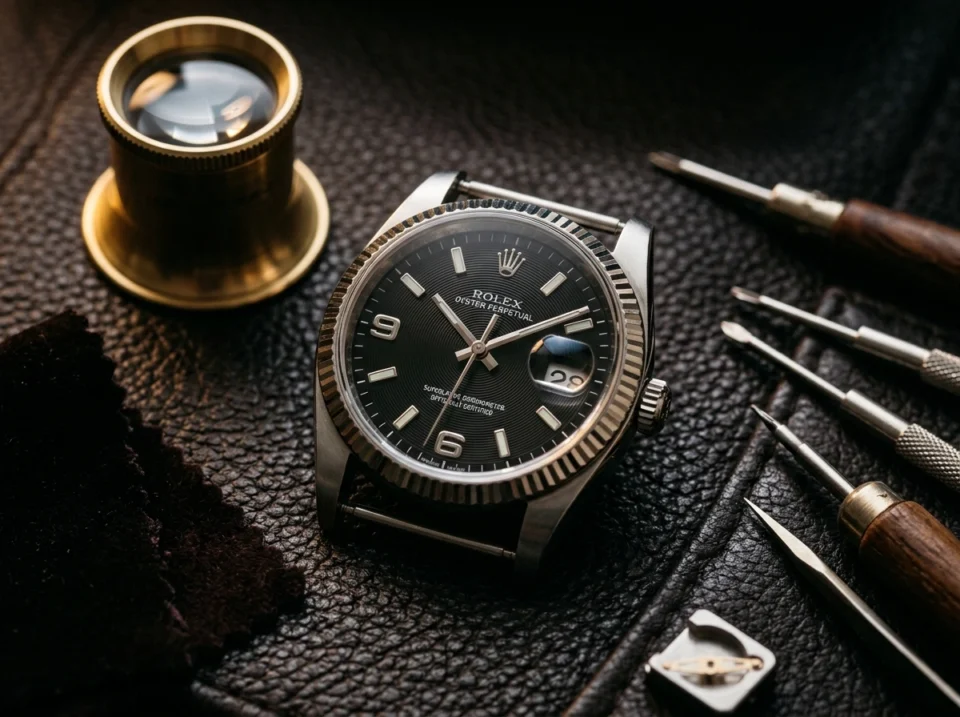
The bezel is the ring that surrounds the watch face. Depending on the model, it might rotate, hold a ceramic insert, or feature engraved markings. Collectors pay close attention to the bezel because details like color, alignment, and the feel of its rotation can reveal a lot about build quality.
When someone mentions a “ceramic bezel” or a “fluted bezel,” they are describing both the material and the style. These details matter to enthusiasts comparing one watch against another.
Rehaut: The Inner Ring
The rehaut is the inner rim between the dial and the crystal. On genuine modern Rolex watches, the rehaut is engraved with text and a tiny logo. Because reproducing this clearly is difficult, the rehaut is a frequent topic in quality discussions.
Beginners will hear people examine rehaut engraving for sharpness, spacing, and alignment. It is one of the small details that hobbyists use to judge the level of care put into a watch.
Cyclops: The Date Magnifier
The cyclops is the small magnifying lens placed over the date window on many Rolex models. It enlarges the date for easier reading. In replica discussions, the cyclops is often scrutinized for its magnification strength and how well it is centered.
A weak or poorly positioned cyclops is a common talking point, so the term shows up regularly in detailed comparisons.
Lume: Glow in the Dark
Lume is short for luminescent material, the substance applied to hands and hour markers so they glow in low light. Collectors discuss lume in terms of brightness, color, and how long the glow lasts.
When you see phrases like “strong lume” or “blue lume,” people are describing the quality and tone of that glow. It is a sensory detail that beginners can easily check themselves.
SEL: Solid End Links
SEL stands for solid end links. These are the metal pieces that connect the bracelet to the watch case. Solid end links are valued because they feel sturdier and fit more snugly than hollow versions.
When a listing highlights SEL, it is pointing to a construction feature that affects both comfort and perceived quality.
AR Coating: Anti-Reflective Layer
AR coating refers to an anti-reflective treatment applied to the crystal. This coating reduces glare and can give the glass a subtle blue or purple tint at certain angles. Enthusiasts mention AR coating when discussing how clear and clean a watch looks under light.
Timegrapher: Measuring Accuracy
A timegrapher is a device that measures how accurately a mechanical movement runs. Hobbyists use it to check things like timing rate and balance. You will often see screenshots of timegrapher readings posted during discussions about a watch’s performance.
For beginners, the key takeaway is that a timegrapher offers a more objective look at how well a movement keeps time, beyond simply guessing.
QC: Quality Control Photos
QC stands for quality control. In this context, it usually refers to photos taken of a specific watch before it is finalized. Buyers review QC images to inspect details like dial alignment, bezel positioning, and lume application.
The phrase “QC pics” is extremely common. When someone asks for QC, they want to examine the actual item rather than generic stock photos.
Common Buying-Related Jargon
Beyond technical terms, the community uses everyday slang during the buying process. Here are a few you are likely to encounter:
- GL: Short for “green light,” meaning a watch looks good to proceed.
- RL: “Red light,” suggesting issues that may need correction.
- TD: “Trusted dealer,” a term members use for sellers they consider reputable, though beginners should always research independently.
- Gen: Short for “genuine,” referring to an authentic watch used for comparison.
- Daily: A watch worn regularly, as opposed to one kept for occasions.
These abbreviations speed up conversations once you recognize them.
Putting It All Together
Learning this vocabulary takes time, and no one expects you to absorb everything at once. Start by recognizing the most frequent terms, then build your understanding as you read more discussions. The more you observe how experienced members talk, the clearer the slang becomes.
This guide is meant purely for education, helping newcomers follow conversations and ask informed questions. As with any hobby, patience and steady research are your best tools. With a solid grasp of the terminology, you will navigate beginner discussions with far more confidence and clarity.
