
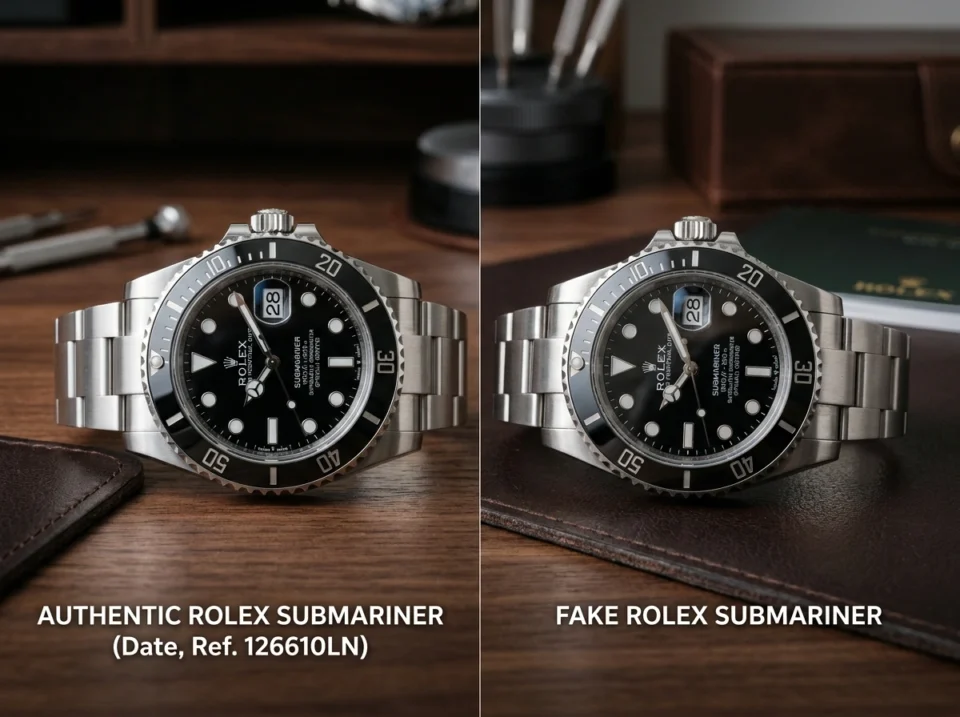
The Rolex Submariner is one of the most recognized watches in the world. That fame comes with a downside: it’s also one of the most copied. Modern replicas have improved so much that a quick glance often isn’t enough to judge what’s real. So how do you actually tell the difference?
The good news is that genuine Submariners carry signature traits that are hard to replicate perfectly. In this guide, you’ll learn what separates an authentic piece from a convincing fake. We’ll walk through craftsmanship, materials, movement, weight, dial details, bezel alignment, engravings, and the finishing on the bracelet and clasp. By the end, you’ll know what to inspect and why documentation and seller reputation matter just as much as the watch itself.
Why Authenticity Is So Hard to Judge
A decade ago, most counterfeits were easy to catch. Today, some replicas use better materials, cleaner printing, and smoother bezels. The gap has narrowed enough that visual checks alone can fool even experienced buyers.
That said, “close” is not “identical.” Rolex builds the Submariner to tolerances that mass-produced copies struggle to match. The trick is knowing exactly where to look and combining several clues rather than relying on a single test.
Craftsmanship and Overall Feel
Pick up a genuine Submariner and the first thing you notice is balance. Edges are crisp, surfaces are evenly finished, and there are no rough transitions between brushed and polished areas.
On many fakes, you’ll find:
- Slightly soft or uneven edges
- Polishing that bleeds into brushed sections
- Tiny gaps where the case meets the bezel or crystal
These flaws are subtle, but they add up. Authentic Rolex finishing looks deliberate everywhere, including the parts most people never examine.
Materials: Steel, Gold, and the Details
Rolex uses 904L stainless steel (marketed as Oystersteel), which resists corrosion and holds a distinctive luster. Counterfeits often use cheaper 316L steel or unmarked alloys that feel and reflect light differently over time.
Gold and two-tone models reveal even more. Genuine gold has a consistent, warm tone, while plated fakes can show wear, color shifts, or a thin, “flat” appearance under bright light. If a “solid gold” watch feels suspiciously light, treat that as a warning sign.
Movement: The Heart of the Watch
The movement is where many replicas fall apart. A genuine Submariner uses an in-house automatic movement engineered for precision and a smooth sweeping seconds hand.
Here’s what to consider:
- Sweep: The seconds hand glides in tiny, fluid steps. A jerky, ticking motion often signals a low-grade movement.
- Accuracy: Real Submariners keep tight time. Cheap fakes can drift noticeably within a day.
- Sound and feel: Winding and setting feel refined on a genuine piece, not gritty or loose.
Opening a case to inspect the movement should be done by a professional, but the visible behavior of the hands already tells you a lot.
Weight: A Quick, Telling Clue
Authentic Submariners feel substantial because of their dense materials and solid construction. Many counterfeits feel light or hollow by comparison.
Weight alone won’t confirm authenticity, since better fakes add mass to compensate. Still, if a watch feels like a toy, that’s a strong reason to keep investigating.
Dial Details: Where Fakes Reveal Themselves
The dial is one of the best places to spot a copy. Rolex printing is razor-sharp, perfectly aligned, and consistent across every marker.
Look closely for:
- Crisp text with no fuzzy edges or uneven spacing
- Evenly applied lume on the hour markers and hands
- Clean coronet logo with well-defined points
- Correct font and proportions for the model and year
Under magnification, fakes often show ragged printing, slightly off-center markers, or lume that looks blotchy. Genuine dials look flawless even when you zoom in.
Bezel Alignment and Action
The Submariner’s rotating bezel should click in firm, precise increments and align perfectly with the dial markers. On authentic models, the bezel turns counterclockwise only, with a confident, even feel.
Common red flags on fakes include:
- A bezel that rotates both directions
- Loose, mushy, or uneven clicks
- Numerals and markers that don’t line up with the dial
Misalignment is a frequent giveaway because precise indexing is difficult to fake at scale.
The Cyclops and Magnification
Above the date, Rolex places a Cyclops lens that magnifies the number roughly 2.5 times, filling the window clearly. Many counterfeits use weaker magnification, so the date looks small or floats in the window.
Tilt the watch under light. On a genuine piece, the date snaps into focus and looks large and centered. A weak or distorted magnification is a classic counterfeit trait.
Serial and Reference Engravings
Genuine Rolex engravings are sharp, deep, and precise. Older models carry serial and reference numbers between the lugs, while newer ones include an engraving on the rehaut (the inner ring around the dial).
Check for:
- Clean, laser-etched engravings rather than shallow or sandy ones
- Consistent font and depth across all numbers
- A tiny Rolex coronet etched into the crystal at the 6 o’clock position on modern models
Fakes often show grainy, uneven, or overly bold engravings that look stamped rather than precisely cut.
Bracelet and Clasp Finishing
The bracelet and clasp receive the same attention as the case. Genuine links fit tightly with minimal rattle, and the clasp engages with a solid, satisfying snap.
Inspect these areas:
- Link finishing: Brushed and polished sections are clean and consistent.
- Clasp mechanism: It feels secure and well-machined, not flimsy.
- Engravings on the clasp: Crisp logos and codes, never blurry.
A loose, rattly bracelet or a clasp that feels cheap is a strong sign something is wrong.
Documentation and Seller Reputation
Even a near-perfect watch should come with a credible paper trail. Authentic Submariners typically include original papers, a warranty card, and ideally service records.
Before buying, take these steps:
- Verify the seller’s history and reviews
- Ask for original documentation and photos
- Confirm the serial and reference numbers match the watch
- Be cautious with prices that seem too good to be true
If you want a deeper breakdown of common counterfeit traits, resources that catalog how a fake rolex submariner is built can sharpen your eye before you commit to a purchase. Pairing that knowledge with a trustworthy seller is your best protection.
Putting It All Together
No single test is foolproof. The smartest approach is to stack evidence: feel the weight, study the dial under magnification, test the bezel, examine engravings, and review the documentation. When several clues agree, you can buy with far more confidence. When even one feels off, slow down.
For high-value purchases, a professional authentication or in-person inspection at an authorized dealer is well worth the cost.
Conclusion
So, can you really tell the difference between a fake and an authentic Rolex Submariner? Often, yes—if you know where to look. Craftsmanship, materials, movement, weight, dial printing, bezel alignment, the Cyclops magnification, engravings, and bracelet finishing all leave clues. Solid documentation and a reputable seller complete the picture.
Treat authentication as a layered process rather than a single test. The more details you verify, the harder it becomes for a counterfeit to slip past you. Your next step is simple: study these markers closely, buy only from trusted sources, and when the stakes are high, get a professional opinion before you pay.
