Expanding a business across international borders brings exciting opportunities for growth, new customer bases, and increased revenue. Companies routinely seek to establish a foothold in major economic centers to maximize their visibility and operational reach. Entering these diverse markets requires meticulous planning, especially when it comes to communication. A single misunderstood clause in a contract or a poorly translated business license can derail years of strategic planning.
New York City stands as a premier gateway for international commerce. Thousands of international corporations, startups, and entrepreneurs flock to the city every year to tap into its immense economic power. Operating in such a global hub means interacting with a massive ecosystem of foreign investors, immigrant workforces, and international partners. You will constantly handle documents originally drafted in languages other than English.
To navigate this complex environment, professional localization is an absolute necessity. However, standard translation is rarely enough for official corporate documentation. Government agencies, federal courts, and major financial institutions demand strict guarantees of accuracy. They need proof that the translated document perfectly matches the original text.
This is precisely where certified translations become critical. Securing accurate, legally recognized document translation protects your company from regulatory penalties, costly delays, and severe reputational damage.
Defining Certified Translation Services
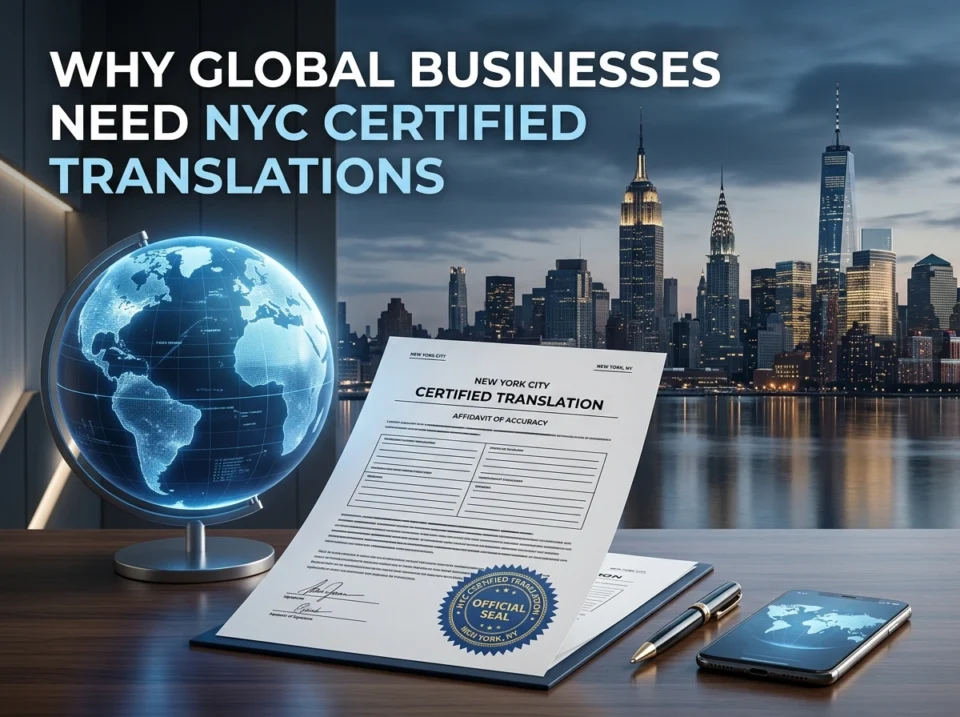
A certified translation is a formally verified document that guarantees the accuracy and completeness of a translation. Unlike a standard translation used for marketing materials or internal emails, a certified translation includes a signed Certificate of Accuracy. This accompanying statement is signed by the professional translator or the translation agency. It officially attests that the translated text is an exact representation of the original source document.
Government bodies and official institutions rely on this certification to process legal and administrative paperwork. For example, the United States Citizenship and Immigration Services (USCIS) mandates certified translations for all foreign-language documents submitted for visas, green cards, and naturalization applications. The certification must meet specific federal formatting and wording requirements, such as those outlined under 8 CFR 103.2(b)(3).
These services handle highly sensitive materials. Professional translators who provide certified documents undergo rigorous training. They possess a deep understanding of legal terminology, syntax, and cultural nuances in both the source and target languages. By working with credentialed professionals, businesses ensure their official documents hold up under intense legal scrutiny.
Legal and Regulatory Compliance for International Business
Global businesses face a maze of legal and regulatory requirements. When your company opens an office in a new country or hires international talent, you must submit a mountain of paperwork to local authorities. In the United States, this includes corporate registrations, articles of incorporation, tax records, and employee background checks.
If any of these original documents are in a foreign language, you cannot simply translate them yourself. Regulatory agencies reject self-translated documents, as well as those translated by unverified third parties. Submitting uncertified documents leads to immediate application rejections. This causes severe operational delays, pushing back launch dates and potentially costing your business millions in lost revenue.
Furthermore, international litigation and arbitration require pristine documentation. If a contract dispute arises, foreign language evidence must be presented to the court. The U.S. District Court, along with local state courts, only accepts certified translations of evidence exhibits, affidavits, and legal pleadings. Compliance is not optional in these scenarios. It is a strict legal mandate that dictates whether your business can successfully operate and defend itself in a foreign market.
Why New York is the Hub for Global Certified Translations
New York City is one of the most linguistically diverse metropolitan areas on the planet. According to the US Census, over 70% of residents across the five boroughs speak a language other than English at home. Spanish, Chinese, Haitian Creole, and Russian are just a few of the hundreds of languages echoing through the streets of Manhattan, Brooklyn, and Queens.
This incredible linguistic diversity creates a massive, constant demand for professional language services. Businesses operating in New York regularly interface with local institutions that require strict document verification. For instance, immigration attorneys in Lower Manhattan constantly prepare naturalization packets for the USCIS New York City Field Office. Corporations submit foreign contracts to the New York County Civil Court.
Because of this high volume of international activity, New York has cultivated a highly specialized translation industry. The city boasts a dense concentration of American Translators Association (ATA) members and legal linguistics experts. When companies need to translate complex legal and business documents, they turn to New York professionals who understand the specific requirements of the local and federal institutions based in the city.
The Risks of Non-Certified Translations in High-Stakes Environments
Cutting corners on translation carries enormous risks for global enterprises. Relying on basic machine translation or bilingual employees for official documents often results in critical errors. A simple mistranslation of a financial figure or a legal obligation can completely alter the meaning of a contract.
When you submit non-certified documents to government agencies, the most immediate risk is outright rejection. If you are applying for an H-1B visa for a crucial foreign executive and provide an uncertified translation of their academic transcript, USCIS will deny the application. The executive will not be able to legally work for your company, halting your operational plans.
The financial and legal consequences extend far beyond delayed applications. Inaccurate translations in compliance documents can trigger audits and hefty regulatory fines. In a courtroom, a poorly translated piece of evidence can lose a case, costing a company significant legal fees and settlement payouts. High-stakes environments demand absolute precision. Certified translations eliminate the ambiguity and provide a legally binding guarantee of accuracy.
Enhancing Brand Credibility in Global Markets
Accurate communication does more than satisfy legal requirements. It builds a foundation of trust with your international stakeholders. When you present perfectly translated, certified documents to foreign investors, partners, and clients, you project professionalism and competence.
Global partners want to know that you respect their language and their legal systems. Providing certified translations of partnership agreements, financial disclosures, and corporate bylaws demonstrates a commitment to transparency. It shows that your business takes international operations seriously and is willing to invest in meticulous compliance.
Conversely, presenting documents riddled with errors damages your brand’s reputation. It signals a lack of attention to detail. If a company cannot properly translate its own business license, foreign partners will likely question its ability to handle complex international logistics. Certified translations safeguard your brand’s image, ensuring that every official interaction reinforces your credibility in the global marketplace.
Industry-Specific Needs: Legal, Financial, and Healthcare
Different industries face highly specific translation challenges. A one-size-fits-all approach fails when dealing with specialized corporate sectors.
Legal Sector
Law firms and corporate legal departments handle a constant flow of foreign language documentation. They require certified translations for court transcripts, witness testimonies, patents, and intellectual property filings. Translators working in this field must understand complex legal doctrines and ensure that the translated text carries the exact legal weight as the original. A minor shift in terminology can change the outcome of a multi-million dollar lawsuit.
Financial Sector
Global financial institutions manage cross-border mergers, international audits, and foreign investments. They need certified translations of bank statements, tax returns, auditor reports, and shareholder agreements. Financial translators must possess extreme numerical accuracy and a strong grasp of international accounting standards. Regulatory bodies like the SEC demand precise, certified documentation to prevent fraud and ensure market transparency.
Healthcare and Pharmaceuticals
The medical industry deals with life-or-death information. Pharmaceutical companies conducting international clinical trials must submit certified translations of medical records, patient consent forms, and drug efficacy reports. Hospitals and healthcare networks need certified translations of patient histories to provide safe, effective care. Accuracy in this sector is heavily regulated by local health departments and federal agencies to protect public safety.
How to Choose the Right Certified Translation Partner in NYC
Selecting the right translation agency is a critical business decision. You need a partner who understands the rigorous demands of global commerce and local New York institutions.
First, look for agencies that employ native-speaking translators who are members of professional organizations, such as the American Translators Association (ATA). These credentials indicate a high level of professional training and ethical standards. Second, verify that the agency provides a signed Certificate of Accuracy with every document. This certificate must be accepted by major institutions like USCIS, federal courts, and universities.
Turnaround time is another crucial factor. Business moves quickly, and missing a court filing deadline or a visa application window can be disastrous. Ensure your chosen partner offers fast, reliable delivery options, including rush services for urgent filings. For comprehensive and reliable support, global businesses routinely turn to certified translation services new york to handle their most sensitive documents. A reputable local agency will offer secure document upload portals, transparent pricing, and notarization options for an extra layer of authentication.
Future-Proofing Your Business with Accurate Communication
Operating a global business requires strategic foresight. As international markets become more interconnected, the volume of cross-border documentation will only continue to grow. Companies that establish robust, compliant communication pipelines today will be best positioned to scale efficiently tomorrow.
Investing in professional, certified translation is not just an administrative checkbox. It is a strategic asset that protects your business from legal liabilities, accelerates your market entry, and builds enduring trust with international partners. By prioritizing accuracy and compliance, you create a solid foundation for sustainable global growth. Secure your corporate documents with certified experts, and navigate the international business landscape with total confidence.
